Compliance-Ready AI: Aligning with EU AI Act & GDPR
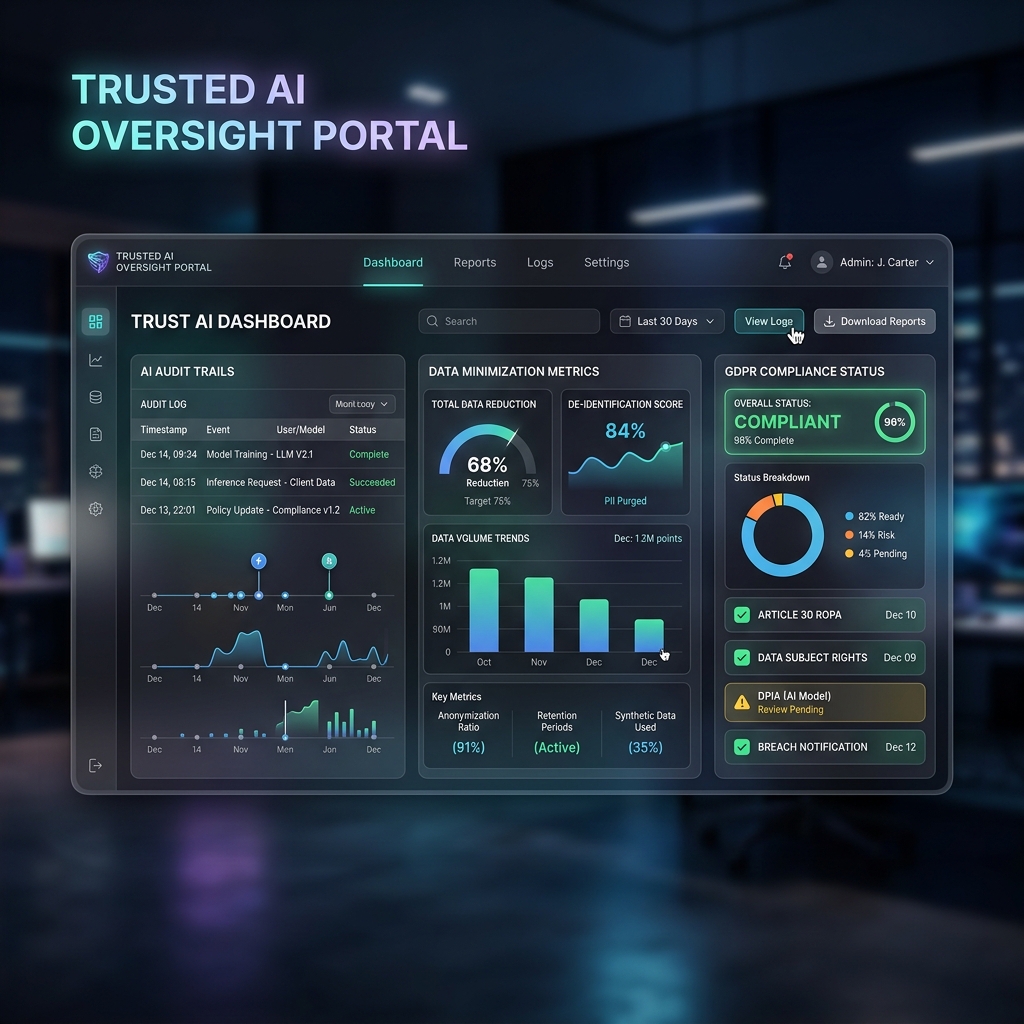
Deploying AI at scale in today's regulatory environment requires more than just high-performing models—it demands rigorous, provable compliance. With the enforcement of the EU AI Act and the ongoing stringency of GDPR, enterprises face immense pressure to align their autonomous agents with strict legal requirements. Building compliance-ready AI from day one is not just a legal necessity, it's a strategic advantage.
The Intersection of AI Autonomy and Regulation
The EU AI Act categorizes AI systems by risk, placing stringent requirements on "high-risk" applications. For enterprises deploying AI agents that handle sensitive data or execute financial transactions, proving compliance means providing clear documentation, robust human oversight mechanisms, and deterministic guardrails. Without a trust validator framework, the non-deterministic nature of large language models (LLMs) makes this nearly impossible.

Data Minimization at the Core
Under GDPR, the principle of data minimization dictates that AI systems should only process the data absolutely necessary for a specific purpose. This means building secure pipelines that filter, anonymize, and compartmentalize data before it ever reaches an LLM.
- Dynamic Filtering: Removing Personally Identifiable Information (PII) automatically at the ingestion layer.
- Ephemeral Processing: Ensuring sensitive context is cleared from memory immediately after inference.
- Hardware-Isolated Enclaves: Processing data in Trusted Execution Environments (TEEs) where even system administrators cannot access the raw memory.
Audit Trails and Impact Assessments
Regulators require proof, not promises. The cornerstone of compliance-ready AI is the generation of immutable, cryptographically verifiable audit trails. Every decision an AI agent makes, every intent it formulates, and every action it executes must be logged and hashed.
When legal or compliance teams conduct Data Protection Impact Assessments (DPIAs), they need access to structured, transparent logs that clearly trace how an AI arrived at a specific decision. Modern AI trust frameworks automate the generation of these compliance logs, turning a historically manual and error-prone process into a seamless operational reality.
The Path Forward
Aligning with the EU AI Act and GDPR should not stifle innovation. By abstracting the compliance burden away from the core AI models and into a dedicated validation layer, engineering teams can iterate rapidly without risking regulatory fines. The goal is to build AI that is not only powerful but mathematically proven to be compliant.
Enterprise M&A Inquiry
For technical due diligence or architectural deep-dives into our zero-trust framework, please request access to our tech specs and roadmap.
Request Tech Specs