Silicon-Layer Cryptographic Integrity: Attesting Nvidia Confidential GPUs (Design)
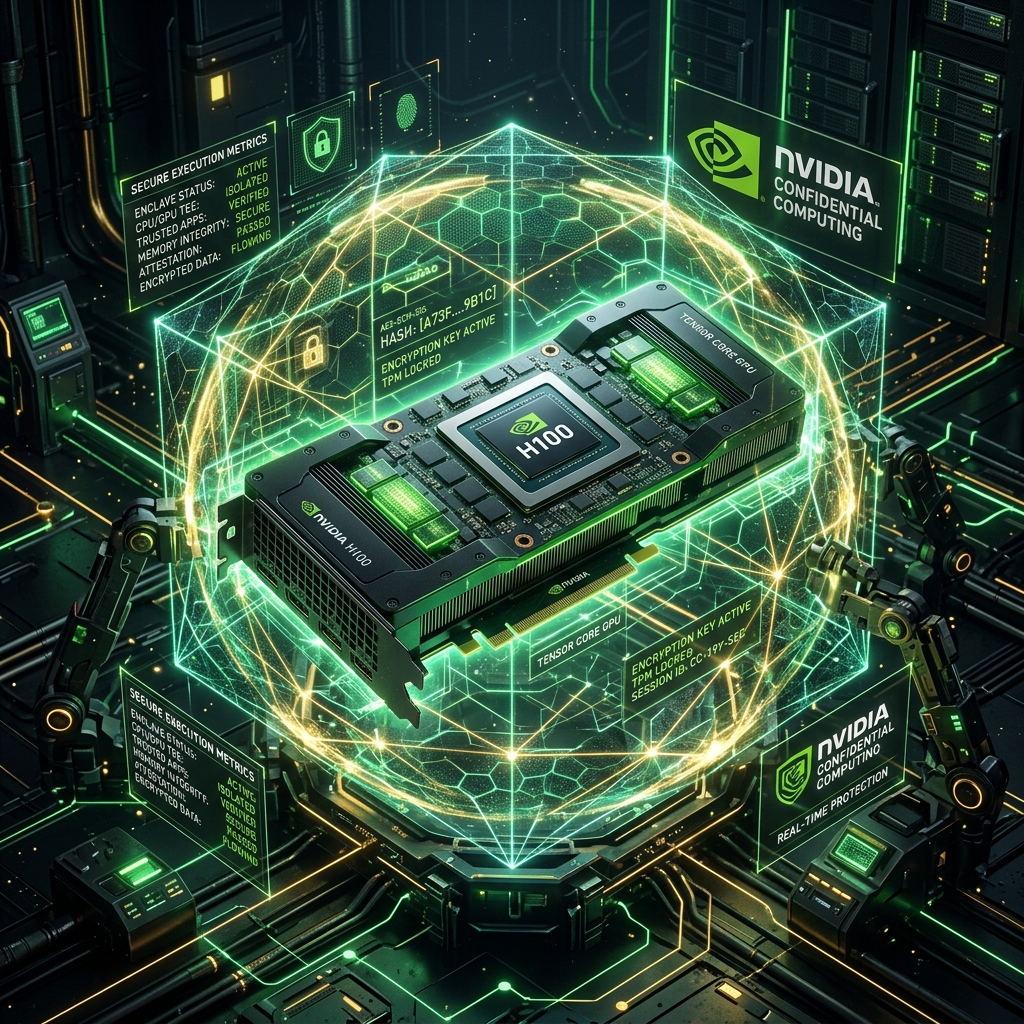
While CPU-based enclaves provide robust logical separation, AI model training and inference require massive parallel compute workloads that only high-end GPUs can deliver. Training a proprietary LLM costs millions of dollars; protecting these weights from exposure in high-bandwidth GPU memory (HBM) is essential. ATL-Trust is designed to leverage Nvidia Confidential Computing technology on H100 and H200 GPUs to achieve cryptographic validation directly at the hardware silicon layer.
The Risk of Unencrypted HBM Memory
Modern GPUs execute compute kernels across thousands of cores, accessing high-bandwidth memory (HBM) at terabytes per second. During inference, model weights are loaded into HBM in plaintext. An attacker with physical access or root privileges on the server node can leverage PCIe analyzer tools or driver exploits to dump HBM memory, stealing proprietary IP in seconds.
Nvidia Confidential Computing & GSP SPDM
Nvidia Confidential Computing secures this pathway by cryptographically encrypting all communication between the host CPU and the GPU over the PCIe bus using AES-256 keys. Additionally, all contents of the GPU's HBM are hardware-encrypted. The GPU's onboard Security Processor (GSP) manages secure boot states and communicates with the host using the SPDM (Security Protocol and Data Model) standard over MCTP.
Our design outlines verifying the execution environment by querying the GSP to fetch the GPU's hardware signature, confirming that Confidential Mode is active, secure boot is enabled, and the GSP firmware is untampered.
Implementing the Nvidia Attestation Layer
The code segment below illustrates the conceptual validation model of how ATL-Trust parses and verifies the GSP SPDM session token to validate GPU hardware integrity:
# Simulated attestation verification logic (design model, not yet tested against real Nvidia hardware)
def verify_gpu_report(self, report: dict) -> bool:
    # Verify Confidential Mode state
    if report.get("confidential_mode") != "Enabled":
        raise SecurityException("GPU Confidential Mode is disabled.")

    # Verify GPU state digest (firmware configuration integrity)
    actual_digest = report.get("gpu_state_digest")
    if actual_digest != self.expected_gpu_digest:
        raise IntegrityException("GPU state signature mismatch!")

    # GPU Status: SECURE. Model weights isolated in HBM.
    return True
Key Takeaways for Enterprise AI Governance
- Silicon-Level Decoupling: Protects proprietary model weights from extraction at rest and in memory during GPU inference.
- SPDM Validation: Ephemeral SPDM session handshakes prevent man-in-the-middle or replay attacks on the PCIe bus.
- Nvidia Hardware Root: Signatures are backed directly by Nvidia's factory-burned keys, establishing a secure root of trust.
Enterprise M&A Inquiry
For technical due diligence or architectural deep-dives into our zero-trust framework, please request access to our tech specs and roadmap.
Request Tech Specs